No. 308, Gongxin Road, Industrial Park, Dongxing Town, Jingjiang City, Jiangsu Province, China
 [email protected]/ [email protected]
 English
 Español
 русский
 中文简体
中文简体 No. 308, Gongxin Road, Industrial Park, Dongxing Town, Jingjiang City, Jiangsu Province, China[email protected]/ [email protected]
The primary advantage of a Radiant Tube is that it allows a furnace to be heated by direct combustion while completely isolating the combustion gases from the product being processed, giving operators precise atmosphere control, cleaner product surfaces, more uniform heat distribution, and significantly better fuel efficiency than open-flame direct-fired heating methods. This combination of atmosphere isolation and efficient indirect heat transfer is what makes radiant tubes the standard heating technology for controlled-atmosphere industrial furnaces across heat treatment, continuous annealing, galvanizing, and a wide range of other thermal processing applications.
Beyond this core functional advantage, radiant tubes deliver a series of measurable operational, economic, and product quality benefits that explain their continued dominance as the heating method of choice in process furnaces where atmosphere control is a critical requirement. Each of these advantages is examined in detail below, with the engineering and economic rationale behind each one.
Content
The defining structural feature of a radiant tube is that combustion takes place entirely within a sealed tube, with the flame and combustion products contained inside the tube wall and never released into the furnace chamber itself. The furnace chamber atmosphere -- which surrounds the outside of the tube -- is therefore completely independent of the combustion process and can be precisely controlled to whatever composition the process requires.
This separation is essential for a wide range of industrial heat treatment processes that depend on a specific furnace atmosphere to achieve the required metallurgical result. Bright annealing of stainless steel strip, for example, requires a hydrogen-nitrogen atmosphere with extremely low oxygen and moisture content to prevent surface oxidation and preserve the bright, reflective finish of the strip as it exits the furnace -- a result that would be impossible to achieve if combustion gases, containing water vapor and carbon dioxide, were allowed to mix directly with the furnace chamber atmosphere as occurs in direct-fired furnace designs.
Galvanizing line furnaces similarly depend on radiant tube heating to maintain the reducing or controlled atmosphere required to prepare the steel strip surface for zinc coating adhesion, while carburizing and case-hardening furnaces use radiant tubes to maintain carbon-rich atmospheres of precisely controlled composition that direct combustion gases would otherwise disrupt or contaminate.
Because the process atmosphere in a radiant tube furnace is isolated from combustion byproducts, the product being processed is never exposed to the moisture, carbon dioxide, sulfur compounds, or particulate matter present in combustion gas streams. This isolation has a direct and measurable effect on the surface quality of the finished product.
Direct-fired furnaces that expose the product to combustion gases inevitably introduce oxidizing species -- water vapor and carbon dioxide -- into the immediate product environment, leading to surface oxide scale formation that must subsequently be removed by pickling, shot blasting, or other surface treatment processes. Radiant tube furnaces, by maintaining an independently controlled, typically reducing or neutral chamber atmosphere, substantially reduce or eliminate this scale formation, reducing or eliminating the downstream surface treatment processing steps and the associated yield loss and processing cost.
Heat treatment processes such as annealing, normalizing, and stress relieving depend on precise control of both temperature and atmosphere to achieve consistent, repeatable metallurgical properties in the finished product. The independent atmosphere control enabled by radiant tube heating allows furnace operators to maintain tight, repeatable process windows batch after batch or continuously along a process line, supporting the consistent mechanical property specifications increasingly demanded by automotive, aerospace, and precision manufacturing customers.
Radiant tubes transfer heat to the furnace chamber primarily by thermal radiation from their hot outer surface, a heat transfer mechanism that scales with the fourth power of absolute temperature according to the Stefan-Boltzmann law. This strong temperature dependence, combined with the ability to distribute multiple radiant tube elements evenly throughout the furnace chamber, gives furnace designers precise control over the spatial distribution of heat input -- a capability that is more difficult to achieve with a smaller number of large open-flame burners.
Even, well-distributed radiant tube layouts produce more uniform furnace chamber temperature profiles, reducing temperature gradients across the width and length of the process load. Temperature uniformity within plus or minus 5 to 10 degrees C across the furnace chamber is a commonly specified requirement for precision heat treatment applications, and is substantially easier to achieve with a well-designed radiant tube array than with direct-fired burner arrangements, where flame impingement and combustion gas flow patterns can create localized hot and cold zones within the chamber.
Uniform temperature distribution directly reduces the incidence of distortion, uneven hardness, or inconsistent mechanical properties across large or long process loads such as strip steel, wire coils, or batches of formed components processed in box or pit furnaces.
Radiant tube systems, particularly when combined with recuperative or self-recuperative burner designs, achieve substantially higher fuel utilization efficiency than simple direct-fired or non-recuperative heating arrangements, translating directly into lower operating costs over the furnace's service life.
Many modern radiant tube systems integrate a recuperative burner directly into the tube assembly, recovering heat from the hot exhaust combustion gases to preheat the incoming combustion air before it enters the burner. This preheating reduces the fuel input required to reach the same flame temperature and heat output. According to data published by the U.S. Department of Energy's Industrial Technologies Program (energy.gov), recuperative burner systems integrated into radiant tube assemblies can achieve fuel savings of 15 to 30 percent compared to equivalent non-recuperative direct combustion systems, depending on the specific exhaust gas temperature and the efficiency of the recuperator heat exchanger design.
Because radiant tube combustion occurs in a sealed environment isolated from the furnace chamber, combustion air-to-fuel ratios can be controlled and optimized independently of the furnace chamber atmosphere requirements. This allows radiant tube burners to operate closer to their stoichiometric (ideal) air-to-fuel ratio without concern for the chamber atmosphere composition, improving combustion efficiency and reducing the energy wasted in heating excess combustion air that direct-fired systems often require to maintain a specific chamber atmosphere balance.
Because combustion gases remain contained within the radiant tube and are exhausted through a dedicated flue system rather than mixing with and diluting the furnace chamber atmosphere, the total exhaust gas volume that must be heated and subsequently vented is typically lower than in equivalent direct-fired systems that rely on excess combustion air to manage chamber atmosphere composition, contributing to overall improved thermal efficiency of the furnace system.
Because combustion does not occur within the furnace chamber itself, radiant tube furnaces do not accumulate the soot, carbon deposits, and combustion particulate buildup on chamber walls, refractory surfaces, and product handling equipment that can occur in direct-fired furnace designs, particularly when operating with rich or incompletely combusted fuel mixtures.
This reduces the frequency and labor cost of furnace chamber cleaning and refractory maintenance, and importantly, eliminates the risk of contamination of the process load by combustion particulate matter -- a critical consideration in applications such as bright annealing, galvanizing pretreatment, and any process where surface cleanliness is a key quality specification. Furnace chamber refractory life is also typically extended in radiant tube systems compared to direct-fired designs, because the refractory is not subjected to direct flame impingement or the localized thermal and chemical stresses that an open flame can create at the point of contact with chamber surfaces.
Because the furnace chamber atmosphere in a radiant tube furnace is generated and controlled independently of the combustion process, furnace operators have complete flexibility to select the chamber atmosphere composition that best suits their specific process requirement, without any constraint imposed by the combustion chemistry of the heating system itself.
| Process Application | Typical Required Atmosphere | Why Independent Atmosphere Control Matters |
|---|---|---|
| Bright annealing | Hydrogen-nitrogen, low dew point | Prevents surface oxidation; preserves bright finish |
| Carburizing / case hardening | Carbon-rich endothermic gas | Precise carbon potential control for case depth |
| Galvanizing pretreatment | Reducing atmosphere | Cleans surface oxides for zinc coating adhesion |
| Stress relief annealing | Neutral or inert atmosphere | Avoids surface chemistry change during stress relief |
| Sintering of powder metal parts | Controlled reducing atmosphere | Prevents oxidation during high-temperature bonding |
This atmosphere flexibility means that a single furnace design platform using radiant tube heating can, with appropriate atmosphere generation and control equipment, be adapted to serve multiple different heat treatment processes -- a versatility that direct-fired furnace designs, constrained by the combustion chemistry of their open-flame heating method, cannot easily replicate.
Modern radiant tubes manufactured from high-temperature centrifugally cast alloys are engineered for extended service life under continuous industrial furnace operation, providing a further economic advantage in the form of reduced replacement frequency and lower lifecycle maintenance cost compared to less durable heating element technologies.
Premium niobium-stabilized high-nickel alloys such as HP40Nb, when operated within their rated continuous temperature range and subjected to controlled, gradual thermal cycling, commonly achieve service lives of 5 to 10 years in continuous industrial furnace duty. Centrifugal casting further improves the metallurgical consistency and density of the tube material compared to static casting methods, reducing the incidence of early, defect-driven failures and supporting more predictable maintenance planning across a furnace's operating life. This combination of robust alloy metallurgy and precision manufacturing is what allows radiant tubes to deliver dependable, long-term performance in some of the most thermally demanding industrial environments.
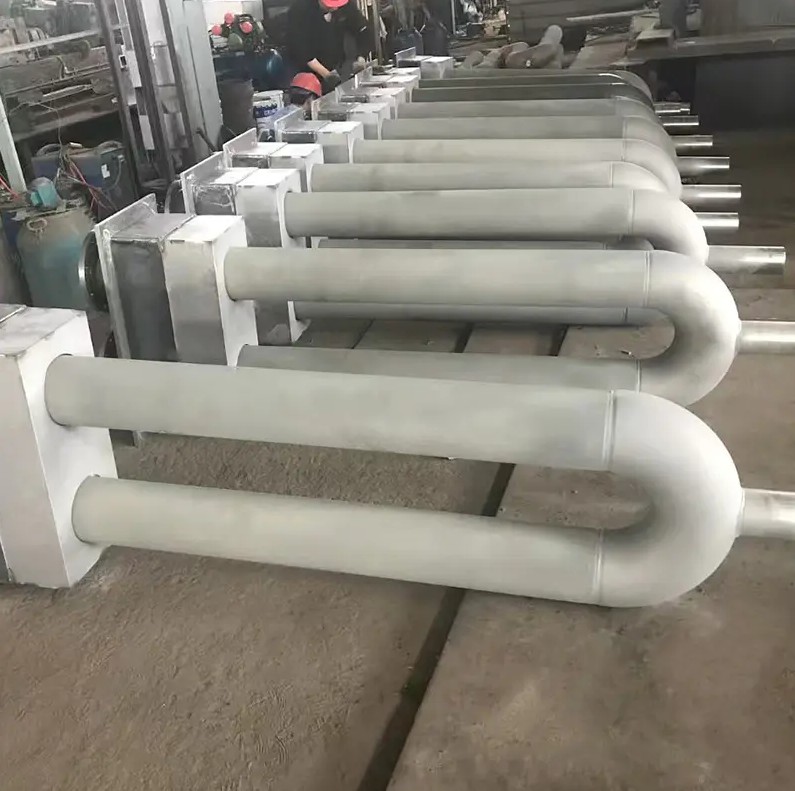
Radiant tubes are manufactured in a range of geometries -- straight single-ended, U-type, W-type, and recuperative P-type configurations -- giving furnace designers the flexibility to select the tube configuration best suited to the specific furnace chamber dimensions, heat input requirements, and burner access constraints of each installation.
This range of available configurations means that radiant tube heating can be adapted to furnace designs ranging from small batch heat treatment furnaces to large continuous strip annealing lines, without requiring a fundamentally different heating technology as furnace scale and configuration requirements change.
The advantages of radiant tube heating are most clearly illustrated through direct comparison with the alternative direct-fired heating approach, where the burner flame and combustion products are released directly into the furnace chamber alongside the product being processed.
| Characteristic | Radiant Tube Heating | Direct-Fired Heating |
|---|---|---|
| Atmosphere control | Fully independent of combustion process | Constrained by combustion gas composition |
| Product surface quality | Minimal scale formation, no soot contamination | Higher scale formation risk; possible soot contact |
| Suitable for controlled atmosphere processes | Yes, standard solution | Generally not suitable |
| Fuel efficiency with recuperation | High; 15 to 30 percent fuel savings achievable | Lower; recuperation more difficult to integrate |
| Chamber refractory and equipment cleanliness | Reduced soot and particulate buildup | Higher buildup, more frequent cleaning required |
While radiant tube heating delivers benefits across a wide range of thermal processing applications, certain industries derive particularly significant value from the atmosphere control, surface quality, and efficiency advantages described above.
Realizing the full range of advantages that radiant tube heating offers depends on selecting a tube specification -- alloy grade, casting method, and geometry -- that is correctly matched to the furnace's operating temperature, atmosphere chemistry, and thermal cycling profile. An undersized or incorrectly specified radiant tube will deliver a reduced version of these advantages, with shortened service life, inconsistent heat distribution, or reduced fuel efficiency compared to a correctly engineered specification.
Furnace designers and operators seeking to capture the full atmosphere control, surface quality, fuel efficiency, and service life advantages described throughout this article should work with experienced radiant tube manufacturers capable of recommending the appropriate alloy and geometry for the specific application. The Radiant Tube product range engineered for industrial furnace heating applications is designed to deliver these combined advantages consistently across heat treatment, continuous annealing, galvanizing, and related high-temperature processing environments, supporting both product quality outcomes and furnace operating economics.
We will reply to you as soon as possible.
 custom alloys for sale
wholesale different alloys
custom alloys for sale
wholesale different alloys